
Cancer Rehabilitation
‘There is no situation, there is no age and no condition where exercise is not a good thing’
Chris Whitty – Chief Medical Officer, England
The advice to all bowel cancer patients when they finish their treatment is:
- Avoid Sedentary Behaviour
- 2 sessions of strength exercise per week
- 150-300 Minutes of moderate to vigorous exercise per week
CHALLENGE CSO2.1 Trial (2009-2024)
This major trial looked at the effect of physical activity for bowel cancer patients that had recently completed treatment.
It showed that adherence to a set of physical activity guidelines:
- Improved overall survival at 5 and 8 years;
- Reduced recurrence.
Guidelines
150-300 minutes of moderate to vigorous activity per week
889 patients on the trial could choose between brisk walking, jogging, running, swimming, cycling and kayaking.
Note: moderate activity requires the heart rate to rise and the individual to feel breathless. What we might otherwise call aerobic activity.
- Half the patients were simply given the information that this would be beneficial.
- Half were supported to adhere to the programme.
The supported group were provided with in-person on online supervision for 3 years.
The results for this group were startling
- 37% reduced risk of death
- 28% reduced cancer recurrence
- Improved Quality of Life
For the health authorities there was also a significant reduction in the associated costs (ie treating recurrence, comorbidities).
Research Paper: https://www.nejm.org/doi/10.1056/NEJMoa2502760
Canadian Cancer Society Article: https://cancer.ca/en/about-us/stories/2025/increasing-colon-cancer-survival-through-exercise
National Guidelines
These guidelines may seem familiar. They are the same guidelines launched by the Chief Medical Officer in Summer 2026.
- 150-300 minutes of moderate activity
or
- 75-150 minutes of vigorous activity
- 2 strength training sessions per week
- Avoid sedentary activity
These national guidelines are evidence-based from research following large numbers of people over decades in various studies around the world.
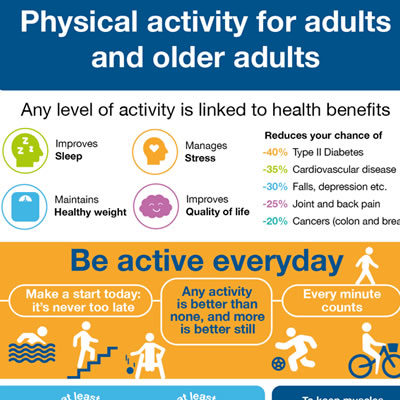
Adhering to these guidelines reduces risk of:
- Cardiovascular disease
- Type II Diabetes
- Some Cancers (breast and bowel)
- Dementia
- Falls
- Joint and Back Pain
Physical Activity has also been shown have many other benefits for the public that also help the cancer patient.
- Improved Sleep
- Maintaining a Healthy Weight
- Managing Stress
- Reduced Depression
- Improved Quality of Life
Cancer and Ageing
Cancer and cancer treatment often have the effect of accelerating the ageing of the individual. One particular factor is sedentary behaviour. Recovering from surgery usually involves rest to allow the incisions to safely heal. The most common side-effect of chemotherapy and radiotherapy is fatigue. Sedentary behaviour has an impact on all of our systems, our cells, metabolism, muscles and mental state.
Sedentary behaviour cause our bodies to age more quickly. We lose muscle, our DNA changes, our immune system weakens, we develop systemic inflammation.
https://pubmed.ncbi.nlm.nih.gov/36599349
For some time it has been realised that physical activity is our best defence against this ageing effect.
What happens to our bodies when we do physical activity?
DNA Health
It may be surprising to find out that exercise isn’t just about your muscles. Exercise has been shown to actively help ageing DNA to repair itself.
Telomeres are codes in DNA that protect genes. As we age these telomeres get shorter and can become critically short, leading to greater risk of mutation or reduced functioning of genes.
Aerobic physical activity over a long period has been shown to reverse the aging process, causing telomeres to increase in length.
https://pmc.ncbi.nlm.nih.gov/articles/PMC8879766
Immune system
Forget about superfoods – they are all hype. Regular exercise helps to improve our immune system, by boosting the important white cells that are our front-line defence against infection.
Inflammation
Inflammation is a known driver for cancer. For more than 20 years now it has been shown that physical activity reduces key markers for inflammation.
https://link.springer.com/article/10.1007/s11332-025-01445-3
Muscle Mass
Sarcopenia is the natural progressive loss of muscle mas and consequently strength as we age. The man cause of this for most people is decrease activity – Sedentary Behaviour. We need activity to maintain our muscle mass.
During cancer treatment people often experience an increased rate of sarcopenia.
https://pubmed.ncbi.nlm.nih.gov/32002684
Consequently, people often feel weak and lack stamina after treatment. This in turn can lead to more sedentary behaviour and further muscle loss. Lack of activity can also be contributory to increase in fat and obesity.
https://link.springer.com/article/10.1007/s10522-015-9631-7/figures/1
Exercise and Physical Activity plays an important role in the reversal of cancer-related sarcopenia.
https://pmc.ncbi.nlm.nih.gov/articles/PMC10741686
How do I improve my physical activity levels?
Getting from fatigue-ridden sedentary behaviour to 150 minutes of aerobic activity a week may feel like an impossible task, but it needs to become your priority.
The cancer journey is not over until you are fit and healthy.
The most important project you will work on is YOU!
Top Tips
- Build it up gradually
- Seek professional help and support
- Develop a routine
- Make physical activity a behaviour
- Let your friends and family know it is the most important thing they can do to help you.
- Consider getting an activity tracker
Routes to Physical Activity:
- Ask your consultant or colorectal nurse specialist for referral to a cancer rehabilitation programme (show them the CHALLENGE TRIAL if they look blank)
- Ask the Macmillan nurse
- Ask your GP about social prescribing fitness programmes
- Contact the local NHS physiotherapy dept
- Check with your district council – they usually have a healthy lifestyles programme
- Check out local gyms to see what they can offer
- Look out for personal trainers that work with the over 50s
- Visit https://www.canrehabtrust.org/ to find a cancer trained instructor near you.
- Join Move Against Cancer. They have online resources to help you. https://www.moveagainstcancer.org/
- Join 5KYW – 5k Your Way – a cancer group that takes part in Parkrun https://www.moveagainstcancer.org/5k-your-way/
- Download C25K app – Couch to 5K https://www.nhs.uk/better-health/get-active/get-running-with-couch-to-5k/
- Sign up to Parkrun and go to your nearest venue – start by accompanying the ParkWalker every week. https://www.parkrun.org.uk/
Using an Activity Tracker/Smart Watch
A Smart Watch type Fitness Tracker can be a valuable tool to monitor your journey back to fitness.
Think of is as an investment in your future health. Increasing your healthy years of life.
Ideally choose one that will:
- You can set goals for activity – eg steps per day.
- Set your 150+ intensity minutes (moderate and vigorous) per week
- Remind you to move and avoid sedentary behaviour
Further Information
For more information about the benefits of physical activity for people affected by cancer visit the Cancer Research UK website
https://www.cancerresearchuk.org/about-cancer/coping/physically/exercise-guidelines